
Synesthesia and Psychedelics
Why might psychedelics sometimes induce temporary synesthesia?

“I never experienced synesthesia before trying shrooms… but my first time doing shrooms I experienced sight, smell, and color as one…” (source)

Most people experience senses as discrete, isolated modalities of perception. A sound is a vibration, a color is a wavelength, a flavor is a chemical binding to certain gustatory receptors on your tongue.
But for some, these discrete sensations blend into one another. This is known as synesthesia.
Researchers categorize synesthesia into three distinct forms:
Congenital/Genuine: Experienced for the entire life, usually from birth.
Acquired: Arising suddenly after brain damage, a stroke, or sensory loss (such as deafness or blindness).
Drug-Induced: A transient state triggered by hallucinogens like LSD or psilocybin.
In this article, I’ll discuss congenital versus chemical synesthesia. I’ll also examine the neuroscience behind how different brain regions communicate with each other and examine a case study of a congenitally blind individual who experienced synesthesia from LSD.
Congenital Synesthesia
Congenital synesthesia is a developmental condition affecting about 2% to 4% of the population. It’s often described as having “wires crossed” in the brain, as it causes two or more senses to be activated in a situation where only one sense responding would be appropriate.
While we usually talk about the five senses, humans have dozens of perception abilities, including balance, time, and language. Because any of these can theoretically bind together, researchers have identified at least 60 distinct forms of synesthesia, with some estimates reaching over 150.
Some defining criteria of “genuine,” congenital synesthesia include:
Involuntary: It is a passive, non-suppressible experience. It cannot be “turned off.”
Consistent: Studies show a consistency rate of over 90% over long periods of time. If the number “5” is hot pink today, it will be hot pink in forty years.
Idiosyncratic: The associations are personal. One person’s “A” will be red, while another’s may be blue.
Unidirectional: Usually, a number might evoke a color, but looking at that color won’t necessarily make you think of the number.
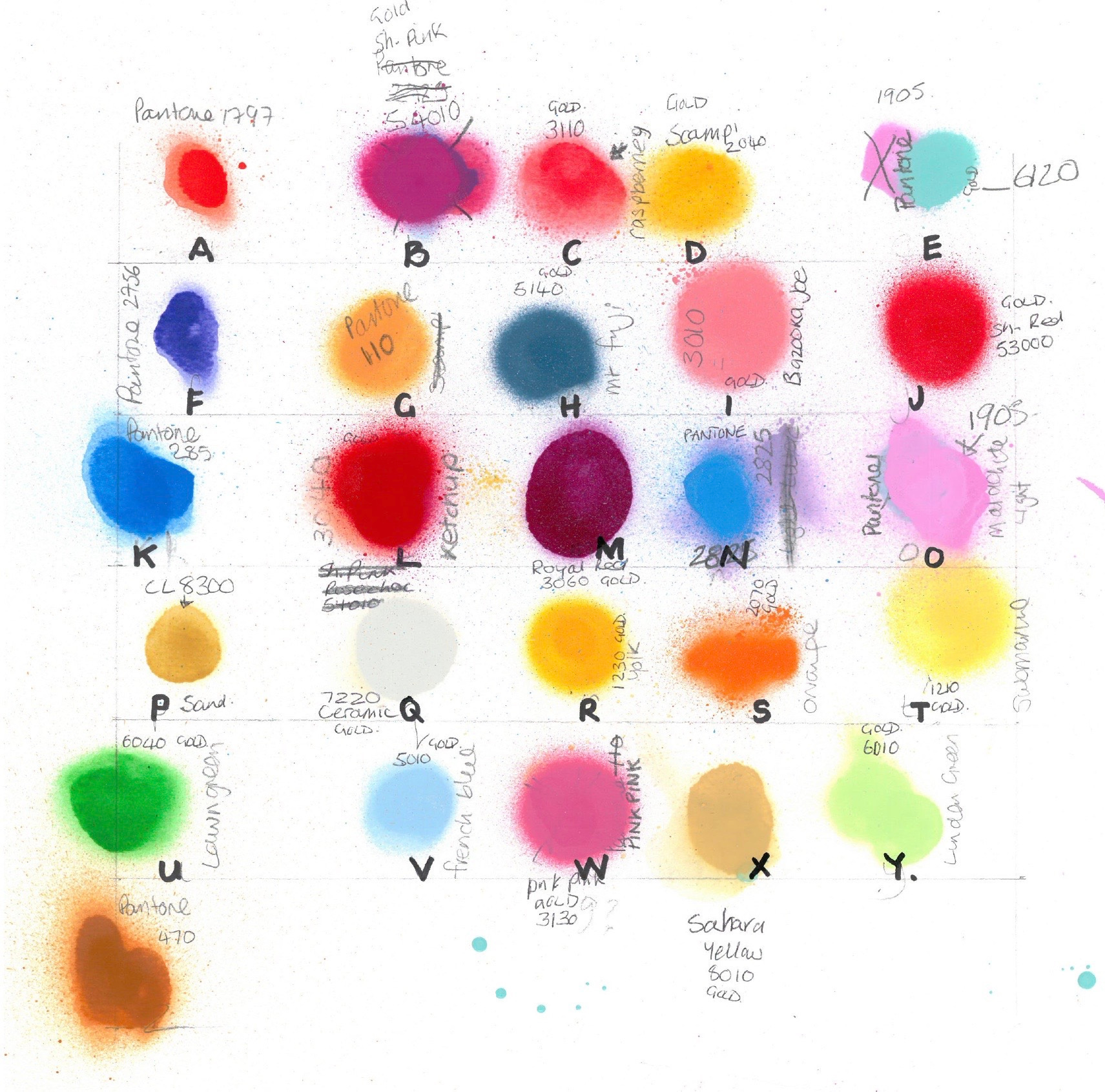
Even within a single type, like grapheme-color synesthesia (the most commonly studied form), the experience varies. Projectors actually see a colored overlay on the page or in the space in front of them. Associators, on the other hand, don’t “see” it with their eyes, but they know with absolute certainty that a letter possesses a specific hue in their mind’s eye. (This relates closely to how we visualize imagery. Relatedly, check out my article on aphantasia!)
Interestingly, we might all be slightly synesthetic to a certain degree. The Bouba/Kiki effect shows that people across various linguistic backgrounds associate jagged shapes with the sound “Kiki” and rounded shapes with “Bouba.” In fact, this phenomenon was even replicated in baby chickens!

Chemical Synesthesia
While congenital synesthesia is a lifelong condition, chemical synesthesia is temporary.
In one study, researchers gave strong doses of mescaline to both congenital synesthetes and controls. Mescaline induced novel experiences of synesthesia in the controls, and it also enhanced the existing synesthesia of the synesthetes.
A survey study found that ~10% of MDMA users and ~27% of ketamine users reported synesthesic effects. Another study examining mescaline, psilocybin, and LSD found that visual patterns were consistently evoked in response to tonal stimuli. Notably, high doses of psilocybin can induce auditory-visual synesthesia in up to 50% of participants.
Examining trip reports from forum sites like Reddit and Erowid provides more insight into the subjective experiences of synesthesia during a psychedelic trip:
Concepts + chords: “More abstract concepts like “pleasure” are almost like a chord progression made of syllable-like sounds. Perhaps, even a full, short song, with melody, harmony, and rhythm. In that particular case, most of the syllables start with an s in short whispery ‘shwi-si-svi’ [slurred]/legato series, in crescendo, forming the backbone of the harmony and pieces of the melody… this ‘song’ somehow seems to fully encapsulate that concept in my mind.” (source)
Color + temperature: “When he changed [the LED lights] to the far red end I felt warm. The further he went blue the colder I got until I would start shivering. As soon as he went back to red I felt warm again.” (source)
Color + intervals: “...different color combinations correlate to different intervals of tones like a third. I sometimes see lines of color change to different notes as well” (source)
Music + flavor: “As the song changed the flavor changed: at one particularly intense part the song got spicy, like black pepper. My senses seemed to all become one sense, and I experienced the incredible sensation of tasting, hearing, seeing, and smelling the song all at once… I ended up sniffing and smacking the rest of the song!” (source)
Chemical synesthesia is almost always transient, meaning it peaks and fades with the drug. However, some even report losing their congenital synesthesia following a psychedelic experience:
“I lost my synesthesia after my last trip… It was a particularly scary/traumatizing trip… sometimes I miss it and wish it came back… To anyone wondering it was sound -> taste synesthesia.” (source)
Neuroscience of Synesthesia
Two architectural models to explain the phenomenological experiences from synesthesia are Cross-Activation and Disinhibited Feedback.
The Cross-Activation Theory suggests a physical difference in brain structure. During neurodevelopment, our brains go through a massive pruning process where unnecessary connections are trimmed.
This theory suggests that in synesthetes, there is a decreased pruning process, leaving extra connections between neighboring regions. For example, for grapheme-color synesthetes, it can be expected that there are extra connections between the area that recognizes letters and the area that recognizes colors.
And as expected, fMRI studies of grapheme-color synesthetes show that the V4 color area and the grapheme area (which recognizes letters) are strongly correlated.
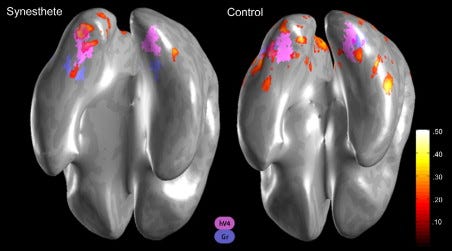
On the other hand, the Disinhibited Feedback Theory argues that these extra connections between different brain regions are consistent across people, but they are usually suppressed or muted by inhibitory neurotransmitters like GABA. Synesthesia would then be the off button being turned off (disinhibition).
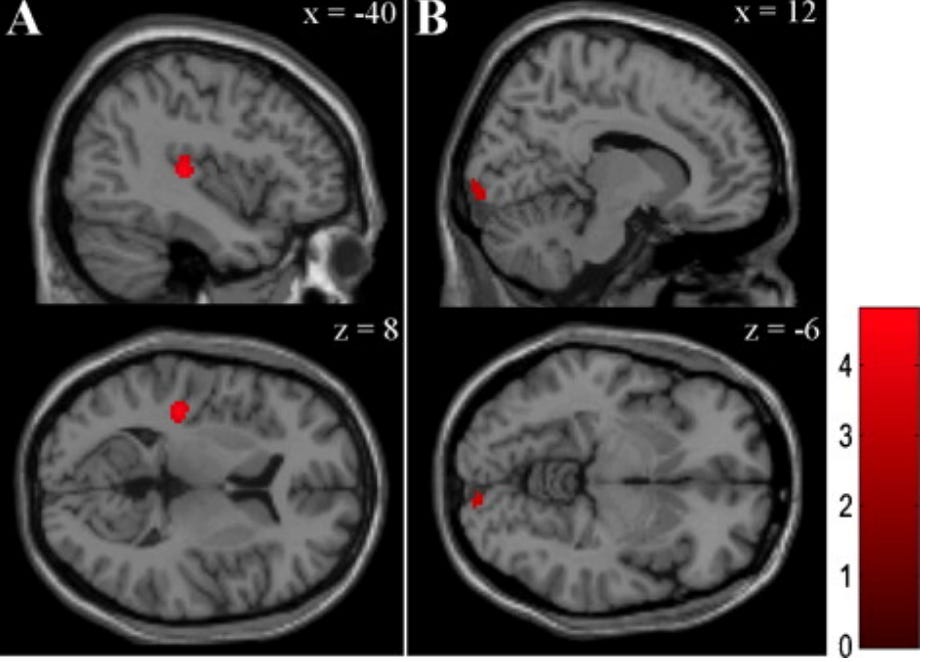
Classic psychedelics like LSD and psilocybin are 5-HT2A agonists. These receptors are prevalent in layer V pyramidal neurons, which are the cells involved in multisensory binding relevant for synesthesia.
Psychedelic drugs result in increased excitation from this increased serotonergic activity, which may mimic the drop in GABAergic inhibition believed to cause synesthesia according to the Disinhibited Feedback Theory.
The debate between extra connections and disinhibition mirrors the research into Phantom Limb Pain (PLP). When someone loses a limb, they can begin feeling phantom sensations in the lost limb within just 24 hours, which is too soon for new physical connections to grow. This implies the potential disinhibition of previously silent connections (a concept called cortical dominance). (Interestingly, psychedelics are being studied for their ability to rewire the brain in PLP. You can check out my previous article on using psychedelics to treat PLP here!)
Congenital Blindness and Synesthesia Case Study
Perhaps the most fascinating case study regarding synesthesia and psychedelics comes from BP, a congenitally blind man who took LSD. Having never had visual experiences, BP lacked any internal concept of what visual stimuli may look like.
When BP took LSD, he experienced synesthesia between sound, touch, and smell. Sounds had physical textures, and musical notes occupied specific spatial locations he could “feel:”
“Sound, touch and smell were experienced at the same time... but it was always the sounds that played a big, big part. I guess my auditory experiences just did it for me!” (source)
This idea bears resemblance to Charles Bonnet Syndrome (CBS). CBS occurs in people who lose their sight later in life. As their vision degrades, their brain begins to “hallucinate” complex, vivid images like people, patterns, or objects to fill the void.
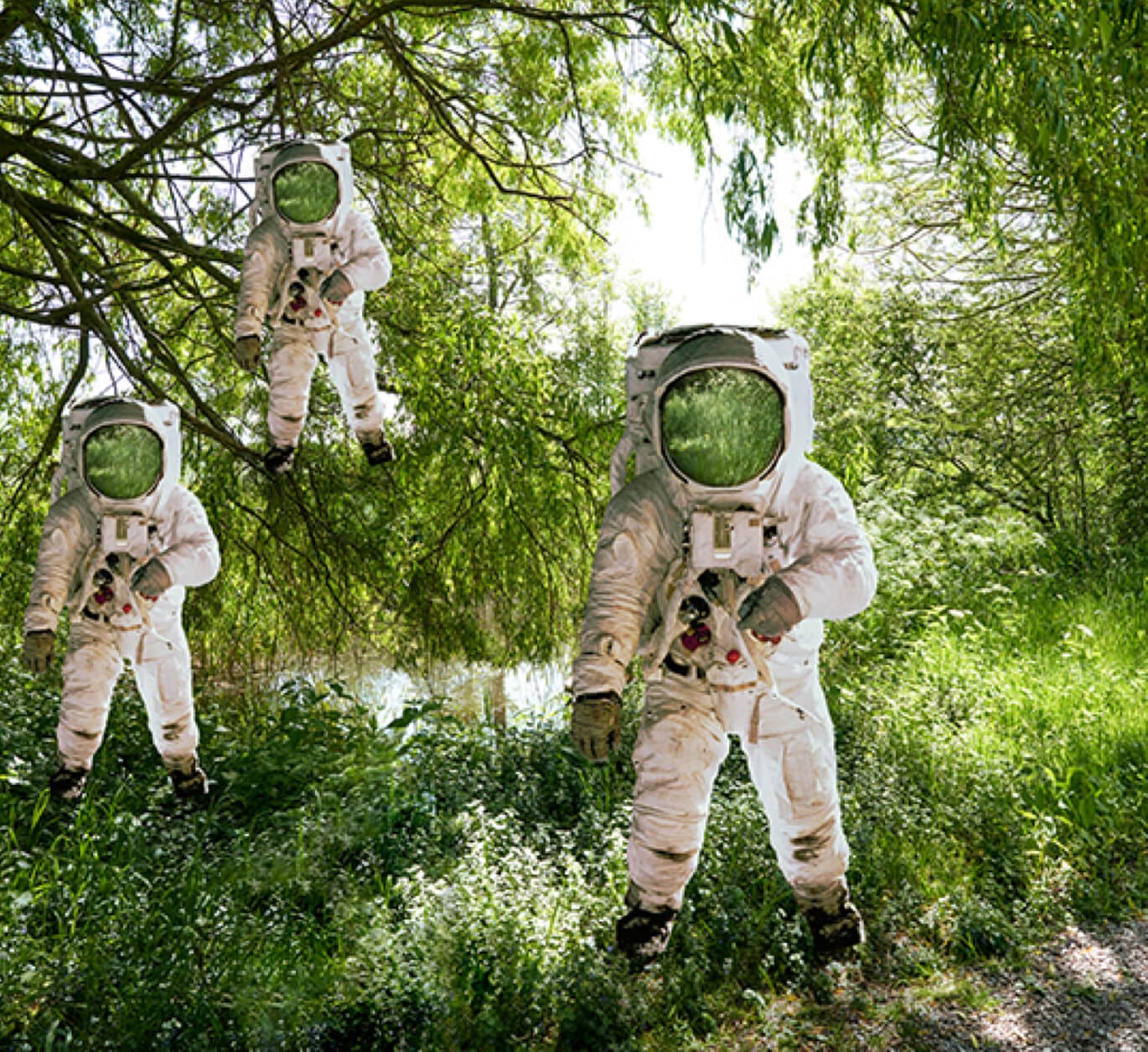
The core mechanism is similar: when the brain is deprived of external input (deafferentation), it lowers inhibitory filters and begins to refer back to stored prior information based on previous experiences.
Because BP was blind from birth, his “hallucinations” couldn’t be visual. BP’s experience perhaps supports the Disinhibited Feedback Theory, at least when it comes to how psychedelics may induce synesthesia. Because BP’s perceptions were built entirely on sound and touch, the introduction of LSD resulted in crosstalk between those modalities, and visual synesthesia was not experienced.
Conclusion
By studying synesthesia and how psychedelics may trigger these states, we can gain interesting and unique insight into how the brain processes and blends sensory information.
The relationship between synesthesia and psychedelics also reveals a mutually beneficial “chicken and egg” scenario often seen in science:
Understanding the neural structures of congenital synesthetes helps us understand how certain molecules could have a role in disinhibition that results in similar phenomenology in non-synesthetic people.
Using chemical synesthesia as a temporary, reversible model allows researchers to study the mechanics of sensory binding, revealing insightful information about perception broadly.